
What Does a Smart Home Mean?
(And What’s the Difference Between a Real “Smart” System and Just Smart Bulbs?)
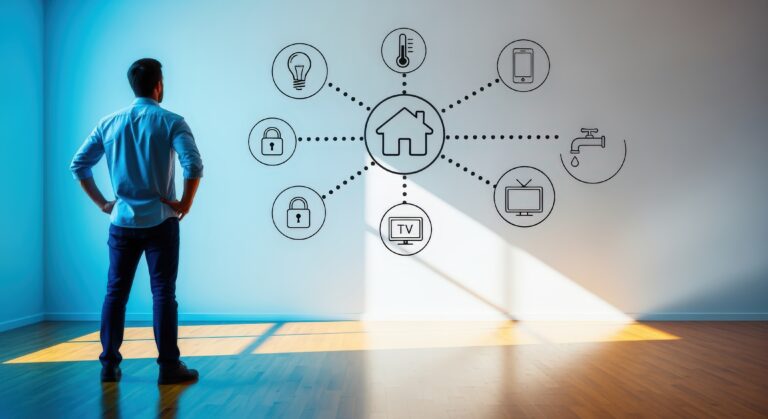
The term “smart home” has become common in Egypt, but many people confuse buying individual smart devices with having a fully integrated smart home system. In this article, we explain the true meaning of a smart home, its main components, how it delivers real value in comfort, security, and energy efficiency, and how to choose the right approach without unnecessary cost or unstable solutions.
1) Simple Definition: What Is a Smart Home?
A smart home is a house equipped with a control and automation system that allows devices and systems to operate:
-
By your command (via mobile phone, tablet, control panel, or smart switches)
-
Automatically, based on scenes, sensors, or schedules
The goal is not the technology itself, but rather reducing daily effort, enhancing security, and optimizing energy consumption.
2) The Difference Between “Smart Devices” and a True Smart Home
A) Standalone Smart Devices
Examples: smart bulbs, smart plugs, Wi-Fi cameras.
These may work well, but often:
-
Each device has its own app
-
Integration is limited
-
Dependence on the internet is higher
-
It’s difficult to build a stable, long-term system
B) Integrated Smart Home System
Here we are talking about:
-
One unified control platform (a single app or centralized system)
-
Integration between systems (lighting + air conditioning + curtains + security)
-
Smart scenes that operate automatically
-
Design and implementation tailored to the client’s needs and budget
The key difference: a smart home is a system, not a collection of separate devices.
3) What Can a Smart Home Include? (Key Areas)
A smart home system can be built gradually based on budget. The main components include:
1) Lighting
-
On/off/dimming control
-
Time-based or motion-based control
-
Scenes such as Movie / Sleep / Away
2) Air Conditioning (AC Control)
-
Pre-cooling before you arrive
-
Automatic temperature adjustment
-
Reduced consumption via schedules and sensors
3) Curtains & Shades
-
Open/close based on sunlight timing
-
Integration with lighting and sleep mode
4) Security
-
Motion, door, and window sensors
-
Smart alarm systems
-
Cameras (as needed)
-
Instant mobile notifications
5) Safety
-
Smoke and gas detectors
-
Water leak sensors (especially important for kitchens and bathrooms)
-
Automatic shutdown or early warning scenarios
6) Energy
-
Monitoring and measuring electricity consumption
-
Load scheduling
-
Reports that help reduce utility bills
4) What Does the Customer in Egypt Gain Specifically? (Value Proposition)
In the Egyptian market, the four most valued benefits are:
-
Lower electricity bills, especially with AC and lighting control
-
Higher security for family and property
-
Daily convenience (less manual on/off repetition)
-
No wall breaking required, even in finished apartments, when using suitable solutions (wireless or hybrid)
5) Does a Smart Home Require Internet?
General rule:
-
Some functions work locally inside the home
-
Remote control from outside usually requires internet
-
Professional systems are designed so that core functions continue to work even with weak or no internet
The key is choosing a system designed for reliability, not devices that rely entirely on the cloud.
6) Can a Smart Home Be Implemented in a Finished Home?
Yes. In many cases, this can be done without wall breaking using:
-
Wireless solutions
-
Hybrid solutions
-
Smart control modules installed behind switches or inside suitable panels
The deciding factor is not whether the home is finished or under construction, but designing the solution according to site conditions and client needs.
7) How Do You Start Correctly Without Extra Cost?
The most practical approach:
-
Start with a clear value entry point, such as:
-
Security (sensors + Away scene), or
-
Air conditioning (energy savings), or
-
Lighting with basic scenes
-
-
Then expand gradually
This way, you gain immediate benefits and build a scalable system, instead of buying scattered devices.
8) Quick Questions to Know If “Smart” Is Right for You
-
Do you often forget to turn off lights or AC?
-
Do you want to monitor your home while traveling?
-
Do you have children or elderly family members and want higher safety?
-
Do you want solutions without wall breaking?
If you answer “yes” to 2–3 of these questions, a smart home will deliver tangible value for you.